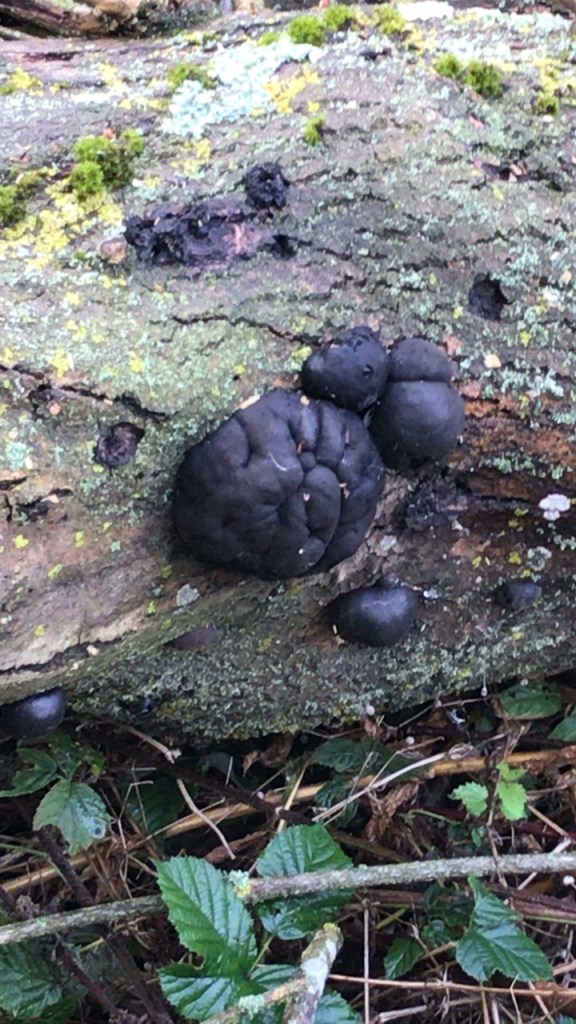
Daldinia concentrica, most commonly known as King Alfred’s Cakes is a fungus which is widespread around the British isles. They are black in colour, roundish shaped and can range in size from 2-10cm across. The fungus which looks like hard, roundish lumps of coal in appearance are stuck to the surface of decaying wood, 2–10 cm across and formally referred to as stroma. Matt, pinkish-brown when young, becoming black and shiny with a ‘burnt’ appearance as they age. The outer shell cracks easily, inside, the flesh is hard and a cross-section shows concentric zones of grey and black. Spores are released from the outer surface of the fungus through perithecia (small beak-like holes), leaving a darker area on the surrounding wood. Cells inside the fruit body eject the spores beyond the edge of the stroma, leaving a black spore print up to 3cm wide around the fungus. The older they get, the darker they become. The fungus will not rot away and can remain on deadwood for years.
The fungus is a useful form of tinder for fire-lighting. The brown variety is usually too heavy and dense to be much good; the black variety is lighter and better. It does need to be completely dry, whereupon it will take a spark from traditional flint and steel. It burns slowly, much like a charcoal briquette, with a particularly pungent smoke. Once lit it usually requires constant oxygen flow to keep burning, such as through swinging the fungus or blowing on it. Fragments can be broken off to expose more embers and transferred to a tinder bundle to create an open flame.
King Alfred’s cakes are common and widespread in the UK. You can spot them in deciduous woodland in groups on dead and decaying wood, especially fallen beech and ash branches.
 Local Wildlife blog - UEA norwich
Leave a comment