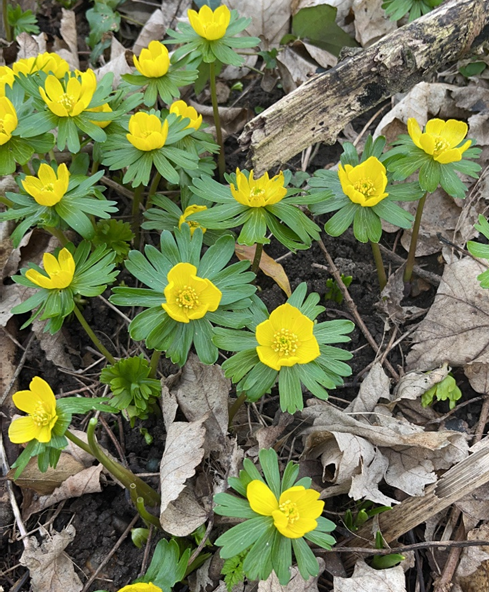
Eranthis is a genus of eight species of flowering plants in the buttercup family Ranunculaceae, the plant is native to southern Europe and east across Asia to Japan and is known as winter aconite. Winter aconite (Eranthis hyemalis) is native to woodlands of France, Italy and the Balkans, but is now widely naturalised across other parts of Europe, including the UK.
The small yellow flowers pop their heads out very early in the year, which is unusual for a flowering plant. However, this fact means that as with everything in nature, there is a reason for this behaviour. As it grows most abundantly in deciduous woodlands, early flowering enables aconite to take advantage of the maximum amount of sunlight penetrating the canopy without the leaves blocking the light. In addition to this, the advantage of early flowering is that there is little competition for light and nutrients in the winter, in fact part of its Latin name hyemalis actually translates as ‘winter flowering’.
Winter aconite is a herbaceous perennials growing to 10–15 cm (4–6 in) tall. The flowers are yellow (white in E. albiflora and E. pinnatifida), and among the first to appear in spring, as early as January in mild climates, though later where winter snowpack persists; they are frost-tolerant and readily survive fresh snow cover unharmed. The leaves only expand fully when the flowers are nearly finished; they are peltate, 5–8 cm diameter, with several notches, and only last for 2–3 months before dying down during the late spring.
Winter aconite is poisonous when ingested by humans, as it contains cardiac glycosides that affect the heart; if ingested in large quantities, it can cause irreparable heart damage. So although beautiful, especially in the context of a barren winter it is not a plant to mess with.
 Local Wildlife blog - UEA norwich
Leave a comment