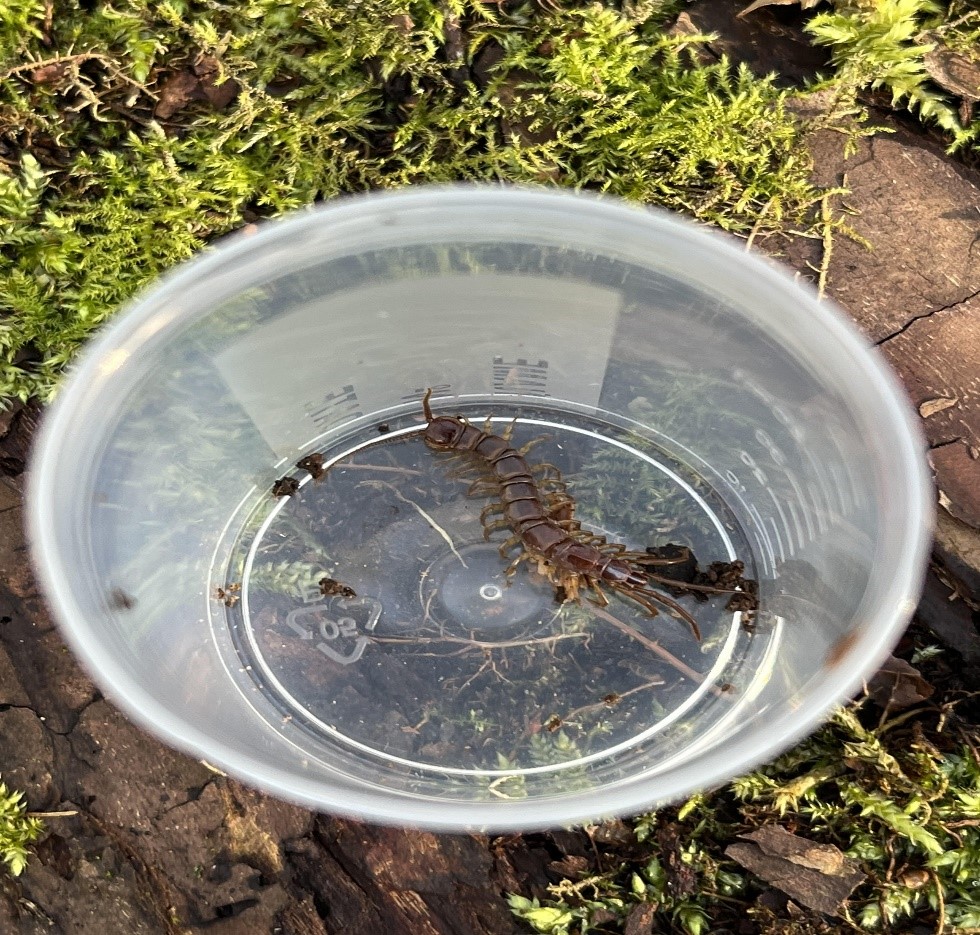
Lithobius forficatus, is most commonly known as the brown centipede, from the family Lithobiidae, most people will have come across one of these in their gardens. The centipede as its name suggests is brown in colour, 2-3 cm long and has approximately 15 pairs of legs, either side of its body, they can be found widely all year round. These long-segmented invertebrates live in the soil, under rocks, in compost heaps, or under the bark of trees, emerging at night to catch their prey. The most familiar centipedes are the Lithobius species, which can be found under rocks in the garden. Although some centipedes do have more than 100 legs, the brown centipede has just 15 pairs – one on each segment of its body. They have venomous claws on each side of their heads, which enable them to catch their prey, and large, biting jaws, but they are harmless to humans.
Lithobius forficatus may live for as long as five to six years. It can be fairly easily identified by its reaction to being revealed, which is to run extremely quickly for cover. This is different from many of the other species of large lithobiid, which tend to be less extreme in their evasion behaviour.
Classified as a predator, its main diet consists of insects and invertebrates, including spiders, slugs, worms and flies. It has specially-adapted front legs which have evolved to resemble ‘fangs’ and they contain venom that allows the centipede to overpower its prey.
Centipedes have poor eyesight, so they use their antennae and long back legs to feel their way around. In order to find a mate, the female releases pheromones which the males respond to. When a male locates a female, he presents her with a silk package containing sperm, which she picks up with special claspers.
 Local Wildlife blog - UEA norwich
Leave a comment