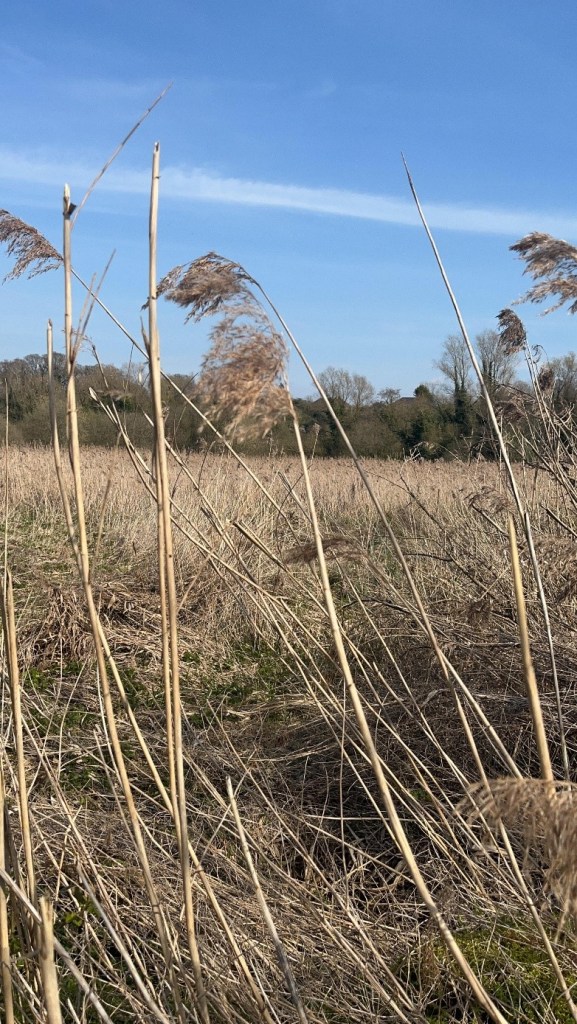
Phragmites australis, or more widely known as the Common Reed forms large beds; it has round, hollow stems, which typically grow to 2 metres in height, but may reach 4 metres. These stems grow from a system of stout, creeping rhizomes. The flat leaves taper into a point, and are attached to the stem by smooth sheaths, which are loose so that the leaves all point in one direction in the wind. The flowers are borne on highly branching purple inflorescences, which measure from 20 to 60 cm in length. The flowers are called spikelet and appear from August to October.
Can be found on mud or in shallow water; it is found in swamps and fens, ditches, at the edges of lakes, ponds, and rivers as well as in coastal lagoons, brackish swamps and estuaries all across Britain. Over time, the reedbeds of Common reed will naturally be encroached by scrub and succeed to woodland if they are left alone. However, for many years they have been cut and managed to produce reeds for thatching buildings. Continuing this form of management keeps the habitat intact, providing a home for specialist wildlife.
Reedbeds can support a wide range of wildlife, provided a variety of ages and structures are present. Bitterns prefer wet reedbeds and feed at the water’s edge where fish are more plentiful, and so favour sites with plenty of pools and ditches. Damp areas support the greatest number of invertebrate species. The drier areas may provide burrowing habitat for water voles and islands may be used by otters. Home to bird species such as reed buntings, reed warbler, bearded tits
Common Reeds are also the primary source of thatch for traditional thatch housing in Europe and beyond. The plant is extensively used in phytodepuration, or natural water treatment systems, since the root hairs are excellent at filtering out impurities in waste water. Phragmites australis also shows excellent potential as a source of biomass.
 Local Wildlife blog - UEA norwich
Leave a comment