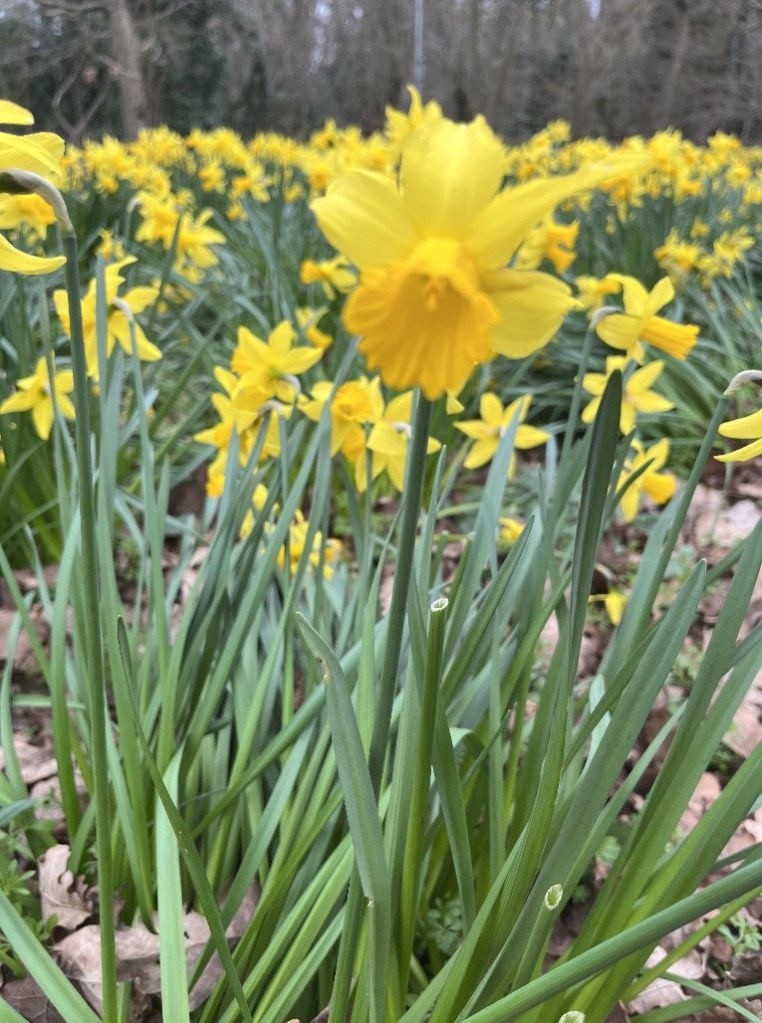
Narcissus pseudonarcissus (commonly known as wild daffodil or Lent lily) is a perennial flowering plant, long, narrow leaves are slightly greyish green with petals and a trumpet centre in various shades of yellow. Daffodils are a common site along roadsides, in parks and in gardens, but to find a true wild daffodil you need to head to the north or south of western England or Wales, with the daffodil being the national flower of Wales. The plant grows from a bulb, with the flowers producing seeds, which when germinated, take five to seven years to produce a flowering plant. The daffodil can grow up to 30cm and is commonly found between March and April, it is welcomed as the first sign of spring returning. The yellow trumpets of daffodils brighten up the dullest late winter/early spring days, but those found on the roadside and in parks are often escaped garden varieties. But these are often the planted or escaped garden varieties. To find a true wild daffodil is a rarer find, a good spot is amongst then shade of an old woodland or in a damp meadow. At one time the daffodil was abundant and hand-picked for markets, this wildflower is now much rarer, having declined during the 19th century as a result of habitat loss. It can be seen in parts of south Devon, the Black Mountains in Wales, the Lake District in Cumbria, and along the Gloucestershire-Herefordshire border.
The wild daffodil has narrow, grey-green leaves and a familiar daffodil flower, but with pale yellow petals surrounding a darker yellow trumpet; this two-tone look is one way to tell them apart from their garden relatives. The wild daffodil is also relatively short and forms clumps, carpeting the ground.
Also commonly known as the ‘Lent lily’ for its long association with Easter celebrations, the wild daffodil got its Latin name, Narcissus, from an Ancient Greek myth. Narcissus fell in love with his own reflection in a pool of water, becoming so obsessed that he fell in and drowned. The nodding head of the wild daffodil embodies Narcissus bending over the water and it’s said that the first flower sprang from where he died.
 Local Wildlife blog - UEA norwich
Leave a comment